

Ellie Simmonds, MSc
University of Bath, Psychology
Ellie Simmonds, MSc in Psychology from University of Bath. Ellie is an associate lecturer on psychometric assessments and has extensive knowledge of the 16-type model.

Not sure what Myers Briggs type you are? Take a free Jungian Type (16 types) test to find out what your type is.
Page contents:
Understanding how INTJ traits manifest themselves in the workplace is useful for successful teams and a fulfilling career. What should INTJs look for in their career choices? What's the best way to manage an INTJ? What should a colleague be aware of working with an INTJ?

INTJs are naturally inquisitive, they enjoy learning about ideas and concepts. A career which would allow reading and investigating on many subjects, even outside of the scope of the main field of work, would be stimulating to an INTJ.
INTJs tend to think deeply about a problem before coming to a decision. A career which allows for a relaxed pace to think deeply through a problem before deciding on the course of action would be favorable.
The skills of an INTJ lend them to being good critics. A career which revolved around checking and correcting the work of others would be compatible with one of their natural talents. INTJs are always looking at how things can be improved.
INTJs favor familiarity and structure. They are most productive when the environment is familiar to them, which might be a regular working pattern, or attending the same workplace each day. A career with a fixed working space for each employee would suit an INTJ more than say one with frequent travel to different sites.

A career in which making snap decisions with little information available, and with significant consequences attached, is far from the conditions in which an INTJ will thrive. Irregularity in the working day or last-minute changes to meetings and plans all unsettle an INTJ's flow.
Similarly, some careers require a huge emphasis on decision-making that isn't logically the best choice, but feels right to the situation. An INTJ career would ideally have very few, or none, of these moments if possible as INTJs have a strong tendency for believing the best decision is to be made based on the facts available.
A career which required someone to quickly build a strong rapport with many new unfamiliar faces with little in common would not suit an INTJ well. For example many cold-calling sales style roles would make an INTJ very uncomfortable. INTJs are better at forming strong connections with a small number of trusted associates.
INTJs generally don't enjoy being the center of attention. INTJs prefer handing the reins to someone else and occasionally chiming in when appropriate. Any role which requires being the conspicuous center of people's attention may make an INTJ feel uncomfortable.
Identifying which type each person who you are managing can help significantly in bringing the best out of your team during any project. INTJs are a valuable addition to any team and their unique preferences can be of great help. Here's a few pointers for managing an INTJ employee to make them happier, comfortable, and productive at work.
INTJs have a respect for rules and deadlines and will strive to meet them, so expect to have them complete tasks and projects in a timely manner. A haphazard workflow or timeline will destabilise many INTJs. Many types would find stop-start projects frustrating, but INTJs are particularly likely to want to reassess the consequences of each delay or missed milestone before being able to focus on the overall project. Keeping an INTJ informed of changing timescales for other areas of the project that they are not directly working on will satisfy their preference for seeing the bigger picture, not just the small section they are working on.

INTJs have respect for deadlines. It's important to respect the significance INTJs place on a deadline.
INTJs will notice malpractices due to their strong belief in what's right and wrong. It's important that they feel they are being treated fairly. INTJs will often expect others to stick to these rules and deadlines and may feel hard done by if they've worked hard to complete a task when other colleagues have not. This could mean that they will be alert to having a greater burden of responsibility or workload placed on them compared to others in the team. In some cases work has to be shared out according to each person's capabilities and expertise, and where this happens be sure to recognize any extra work the INTJ puts in.
INTJs are focused on improvement, and they see it as helpful to point out where other people could improve.
Perceptive INTJs will notice mistakes and errors, and will often take pride in identifying an area where improvement can be made. INTJs don't seek to find fault with their colleague's work; they are simply striving to improve where they see room for improvement.
Understanding how different people behave at work, and what their preferences are, can help make for a more productive and amiable workplace. Let's see what makes an INTJ tick in the context of the workplace.
Most INTJs prefer to be left to focus on their work; they may want to have a workspace free of distractions and chit-chat. This doesn't mean that an INTJ is unfriendly or cannot tolerate background noise, but they do prefer an environment where they can be left alone with their thoughts. Some INTJs may not want to engage in office-chat if it's not relevant to the task at hand but they may still enjoy the company in the background. An INTJ's intuition combined with the desire to have an understanding of the bigger picture makes them happy to chat, provided it helps them understand something.

Analysis and understanding are important to an INTJ. Allow them time with their own thoughts so they can work through problems in their mind.
INTJs prefer to take a step back and absorb what's being said and shared at meetings rather than being the center of attention. This can make an INTJ appear quiet. Allow moments for INTJ colleagues to provide their insight; make a point of asking them their thoughts because they might not volunteer them. Or try directing open questions towards the team as a whole as this can be enough to coax out the ideas an INTJ is running through in their head
Working through a complex problem is an INTJ's idea of fun. Other types will prefer to thrash out a problem as a group, but an INTJ will prefer to quietly solve it on their own.
INTJs enjoy unpicking things and breaking down each argument. This makes them good at spotting errors in people's work. A trait like this, when not expressed sensitively, can be seen by others as offensive. It's important to remember that this is unlikely to be an INTJs motivation and that any criticism is a suggestion for improvement, not a slight on their colleague. Be mindful of this and that an INTJ can be a team member who naturally enjoys what many see as a tedious task: checking for errors.
What are most and least popular INTJ career choices?
Figure 1: Survey data of which careers INTJs currently work in
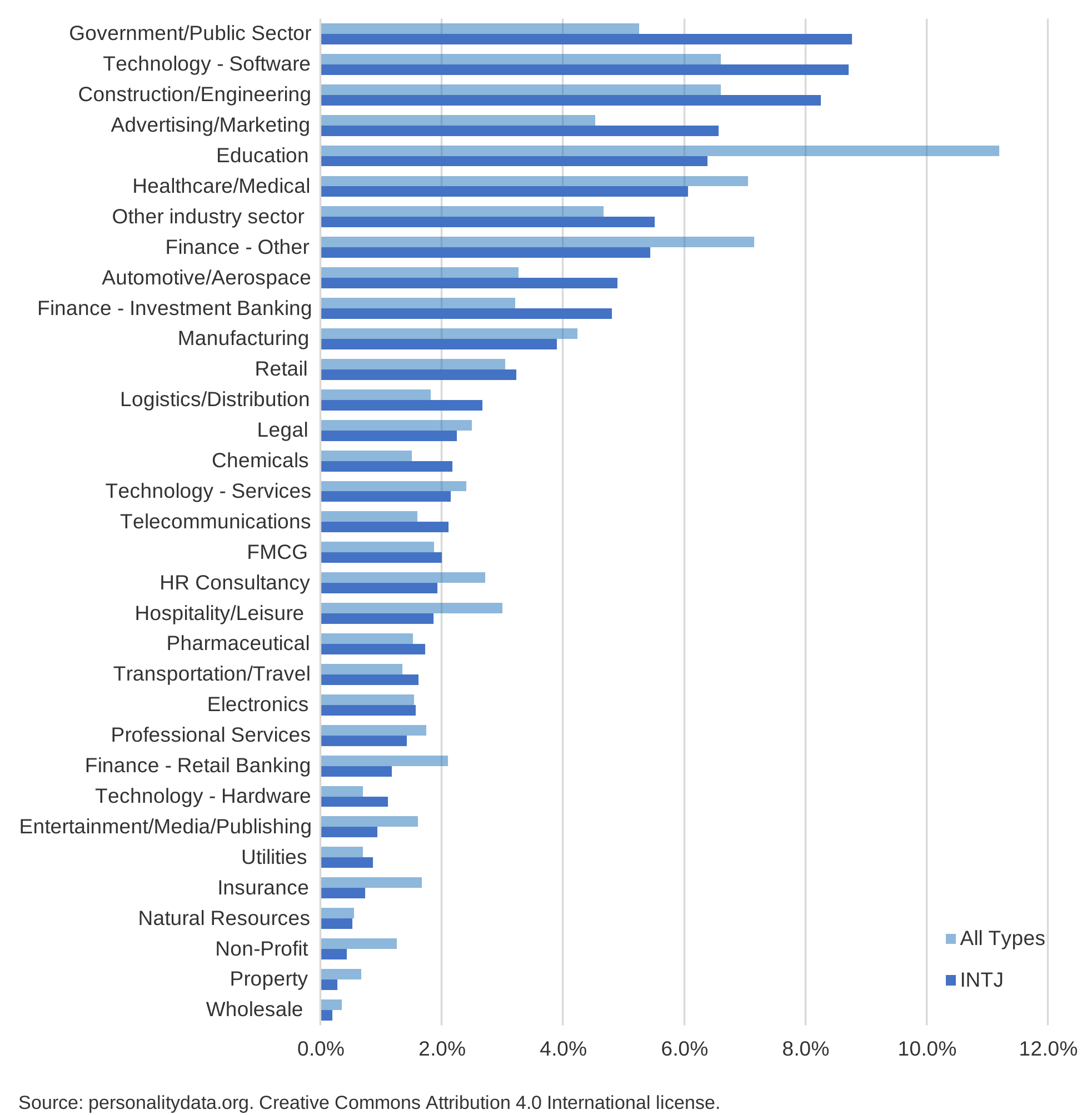
What this chart shows
This chart shows the percent of INTJs who work in each industry sector compared to all types. This highlights which careers have an above-average and below-average proportion of INTJ types working in them.
Notes:
University of Bath, Psychology
Ellie Simmonds, MSc in Psychology from University of Bath. Ellie is an associate lecturer on psychometric assessments and has extensive knowledge of the 16-type model.
 INTJ Relationships
